Design Research · 08 / 08
The Atlassian Question
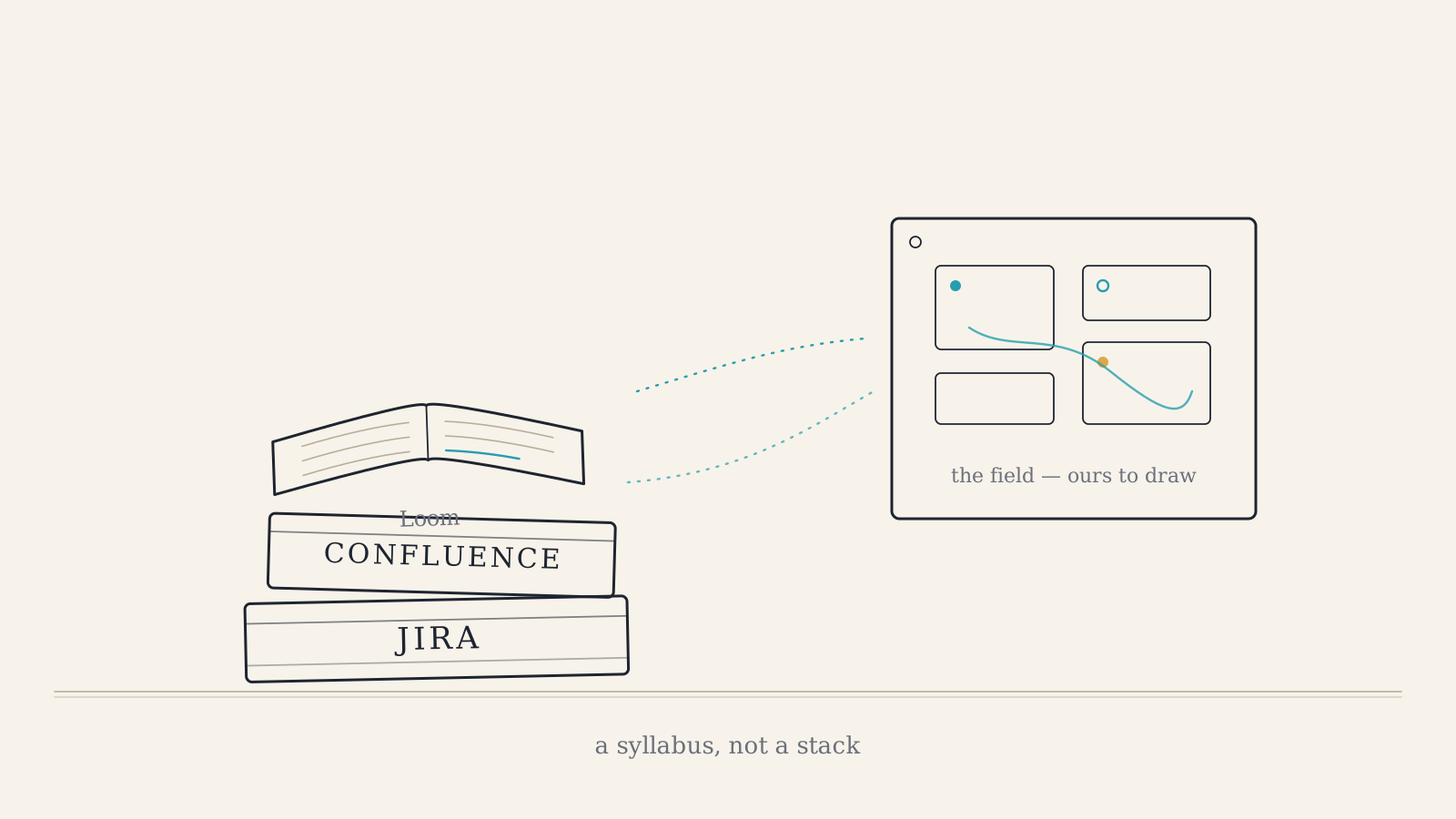
Watching a meeting recording inside an artifact, we found ourselves wishing the video behaved more like Loom. That wish led somewhere uncomfortable: Loom is Atlassian now, and Jira, Confluence, and Rovo are shipping a lot of what Collaboration OS hopes to do. Three questions follow. What can we learn from these tools? Should we use any of them? And what makes this still worth building ourselves?
A Syllabus, Not a Stack
The short answer to all three questions is one sentence: treat Atlassian as a syllabus, not a stack.
Atlassian is horizontal software for internal teams. Its entire economics depend on being everything to everyone — every team size, every industry, every workflow, infinitely configurable. Collaboration OS is vertical software for one relationship: a studio and its clients, curated, branded, and fed with context no horizontal tool can have. That is not a niche Atlassian serves badly; it is a niche Atlassian structurally cannot serve. But each of their products has spent a decade learning something, and each lesson is worth stealing.
What Loom Teaches: Edit Attention, Not Video
Loom's signature moves — silence removal, filler-word trimming, easy speed control, and now an AI note taker that turns calls into recaps and action items — are all answers to the same underlying problem: nobody wants to watch sixty minutes.
Our meeting band is a different answer to the same problem, and arguably a better one for meetings: the TL;DR, the verbatim quotes, the decision cards, and the chapters all seek directly into the moment they came from. Loom compresses time inside the video; the artifact compresses it outside the video, and keeps the full record intact underneath. The compression is legible — you can always see what you're skipping — which matters for a tool whose subject is a client relationship, not a product demo.
The cheap steals are worth taking anyway: playback speed on the embedded player, and perhaps a "play chapters only" mode later. The expensive steal — actual silence-removal processing — we skip. That is a media-pipeline product, and Collaboration OS is a layer, not a pipeline.
On the AI note taker specifically: Loom's is generic. It watches a video cold and guesses at what mattered. Our pipeline knows the engagement, the client, the attendees, and the meeting type before the call happens, and treats the team's live notes as ground truth — because the artifact exists before the meeting (see Meeting Artifacts). That planned-meeting inversion is genuinely ahead of what Atlassian ships, and it only works because we are vertical: a horizontal tool cannot assume your meetings have engagements.
What Confluence Teaches: Knowledge That Stays Alive
Confluence's current pitch — "the one place for all your ideas, docs, knowledge, and human+AI teammates" — rests on two ideas worth taking seriously. Everything is linkable: pages, whiteboards, databases, and videos live in one connected graph rather than a folder of exports. And pages are living documents: Rovo summarizes them, transforms them into timelines and decks, answers questions across them.
Both ideas directly validate the direction the artifacts work is already taking — artifacts as pipeline heads, not termini, feeding a per-engagement decision log and eventually the field itself. A meeting artifact that links to its decisions, its asks, its tasks, and its moments in time is a small Confluence page done with an opinion.
The cautionary lesson is equally valuable. Confluence is famously where documentation goes to die, precisely because a horizontal wiki has no opinion about what matters. Every page is equally important, so none are. The pattern-language guardrails — no fake freshness, Published, Not Leaked, Asked, Not Ambushed (see Through the Pattern Language) — are exactly the opinions Confluence cannot afford to have.
What Jira and Rovo Teach: AI in the Work Graph
Atlassian's bet with Rovo is that AI agents woven through the work graph — reading issues, drafting specs, converting notes into artifacts — beat AI bolted on as a chat sidebar. That is the right bet, and it is the one we already made: n8n and Claude operating over the ClickUp↔Supabase mirror, with every automation reading and writing real work objects.
But adopting Jira itself would mean migrating away from ClickUp to reach feature parity. ClickUp is our Jira. The whole architecture treats the tracker as the system of record precisely so that the tracking layer stays swappable commodity underneath the meaning layer. Nothing about Jira's roadmap changes that calculus; it confirms it.
Should We Use Any of Them?
Not as dependencies. Loom as a personal tool for async video updates to clients is perfectly fine — and if that becomes a habit, "async update" should become an artifact type that flows through the existing recording-and-essence pipeline rather than living in someone else's library. No Atlassian product earns a slot in the stack.
Why We're Still Building It
Try to imagine giving a client stakeholder a login to Jira. They would face an internal tool's interface, per-seat licensing, and a firehose with no curation. Confluence guests fare little better. Atlassian's blind spot — the blind spot of the entire Work OS category, as The Work OS Landscape found — is the client-facing surface: a calm, branded room where a client sees exactly what was published to them, what is asked of them, and the shape of the work over time.
That surface — plus context-fed AI, plus the spatial field — is the whole product.
And because ClickUp stays the system of record, we are maintaining a thin meaning-layer, not a platform. That is the sane version of "doing it ourselves": we never have to win at issue tracking, wikis, or video processing to win at the thing we actually sell, which is a legible relationship.
The Discipline
The rule that keeps this sane: never rebuild what they do well; pour everything into what they can't do.
| Capability | Their answer | Our stance |
|---|---|---|
| Issue & task tracking | Jira | Mirror. ClickUp is the system of record; we sync, arrange, and give it meaning. |
| Team wiki / knowledge base | Confluence | Refuse. Artifacts are opinionated records of moments, not a general wiki. If the team needs a wiki, use one. |
| Video hosting & processing | Loom | Buy. SproutVideo hosts; we skip silence-removal-grade processing. Steal the cheap wins (playback speed, chapters). |
| AI meeting notes | Loom AI / Rovo | Build. Context-fed via planned meetings — engagement, attendees, type, and team notes as ground truth. Generic note takers guess; ours knows. |
| AI over the work graph | Rovo agents | Build. Already live: n8n + Claude over the ClickUp↔Supabase mirror. |
| Client-facing surface | — | Build. Published-not-leaked rooms, asks in the room, brand-fitted calm. This is the product. |
| Spatial field & view models | — | Build. Arrangement as meaning; nobody in the category does this. |
Read down the right-hand column and the shape of the project is clear: everything marked build is something a horizontal vendor cannot do without becoming a different company. Everything marked buy, mirror, or refuse is something we cannot do without becoming a different company. The line between the two is the product strategy.
Deeper Dives
- 08a · The Teamwork Graph — their graph is invisible plumbing; ours is the product. The person is the node.
- 08b · A System of Work — doctrine with software attached; practices over blueprints, and a system of work without an org.
Related Notes
- The Work OS Landscape — the unoccupied position this note defends
- Meeting Artifacts — the planned-meeting inversion and essence-first pages
- The Client Dashboard — why clients want less, published deliberately
- Collaboration OS Through the Pattern Language — the guardrails Confluence can't afford
Sources
- Confluence · Loom · Jira
- Atlassian Rovo — AI agents across the work graph
- Atlassian completes Loom acquisition (2023)